

TL;DR
- Nintendo confirmed the remake of The Legend of Zelda: Ocarina of Time during the June 9, 2026 Nintendo Direct, stating it will be exclusively for the Nintendo Switch 2 and is set to launch in late 2026.
- The remake is described as a 'rebirth' rather than a remaster or port, indicating significant changes and updates to the original game, including modern accessibility options and potential quality of life improvements.
- The visual style of the remake will feature 'stylized realism,' aiming for a more grounded aesthetic while maintaining the essence of the original game, though this has sparked debate among fans regarding the preservation of the original's charm.
Disclaimer: This summary was created using Artificial Intelligence (AI)
The Legend of Zelda: Ocarina of Time Remake is no longer a rumor. Nintendo ended its June 9, 2026 Nintendo Direct with a cinematic teaser that confirmed what insiders had been saying for months: Hyrule is being rebuilt from the ground up, exclusively for Nintendo Switch 2, with a launch sometime in late 2026.
For anyone who grew up mapping Water Temple water levels in their head or burning muscle memory into Epona’s Song, this is the kind of announcement that stops you mid-scroll.
This is not a remaster; it is not a resolution bump either. Not another Switch Online port of the N64 original (which you can already play on the Expansion Pack).
According to Nintendo’s own wording, the 1998 classic is being “reborn” for a new generation, and that word choice is doing a lot of heavy lifting.
We are going to break down exactly what was revealed, what credible insiders have added, what the hardcore community is thinking, and what QoL and mechanical changes we should realistically expect from a 2026 rebuild of the most influential action-adventure game ever made.
See also: Identity V Redeem Codes June 2026: Hidden Freebies?
The Legend of Zelda: Ocarina of Time Remake Expected Release Date
Nintendo’s exact phrasing from the Direct was “The Nintendo 64 classic returns for a new generation in 2026, reborn exclusively for Nintendo Switch 2.” That’s deliberate language. “Reborn” is not the same as “remastered” or “ported,” and Nintendo knows exactly how obsessive the Zelda community is about these distinctions.

The announcement came on June 9, 2026, at the tail end of the Nintendo Direct, which is traditional for something this big.
You save the best for last. The release window is broadly “later this year,” with insiders converging on Holiday 2026 as the most likely window. No specific date yet, but Nintendo has historically given Zelda titles plenty of runway once they are announced.
Expect a dedicated Zelda Direct or a major gameplay reveal within the next few months. The 40th anniversary of the Zelda franchise is the obvious context here.
Nintendo is using this remake as one of its flagship first-party showpieces for Switch 2’s first full holiday season, and that matches the scale of what insiders have been describing.
Leaks also suggest a Zelda-themed Switch 2 hardware bundle could launch alongside the game. Nothing official on that yet, but given how Nintendo handles big tentpole releases, it would be surprising if it didn’t happen.
See Also: Persona 6: Release Leaks, Dark Horror Tone & New Gameplay
The Reveal: Legend of Zelda Ocarina of Time Remake Trailer, Every Detail Worth Noting
The trailer is short. Under a minute, no gameplay, no dungeons, no combat. For a lot of players that’s frustrating, and that frustration is understandable. But what’s there is worth looking at carefully.
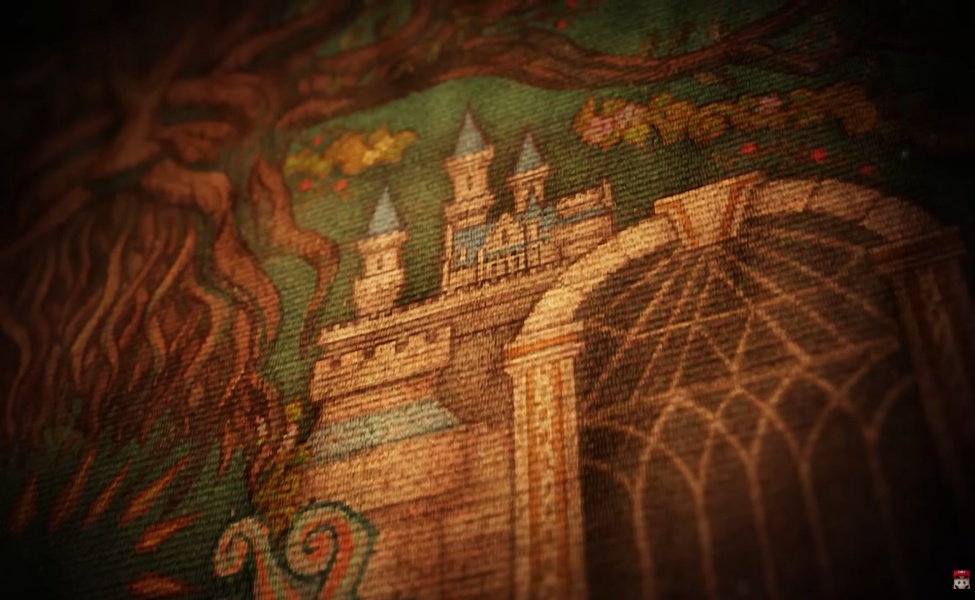
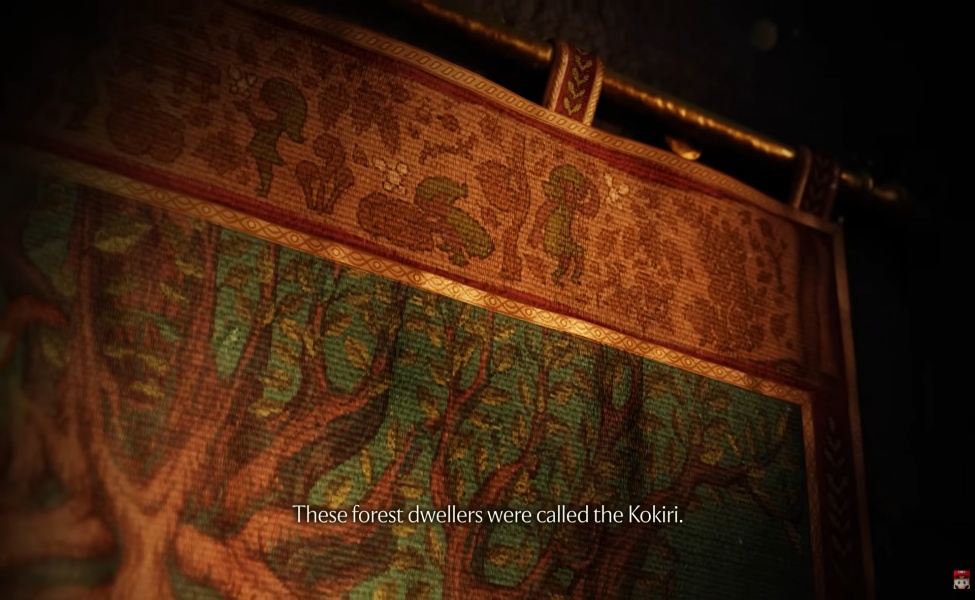
It opens with a sweeping camera over a richly detailed tapestry depicting Hyrule’s history; the Great Deku Tree’s narration mirrors almost word-for-word how the 1998 game opened. The Kokiri children, the forest, the boy without a fairy.
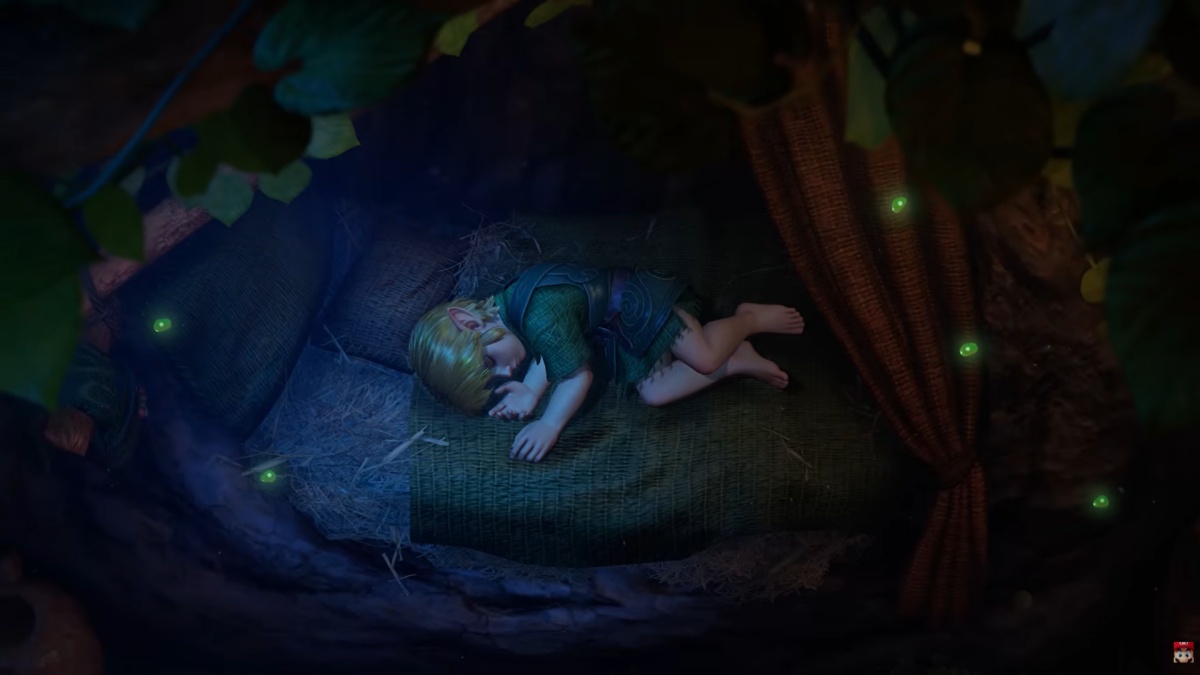
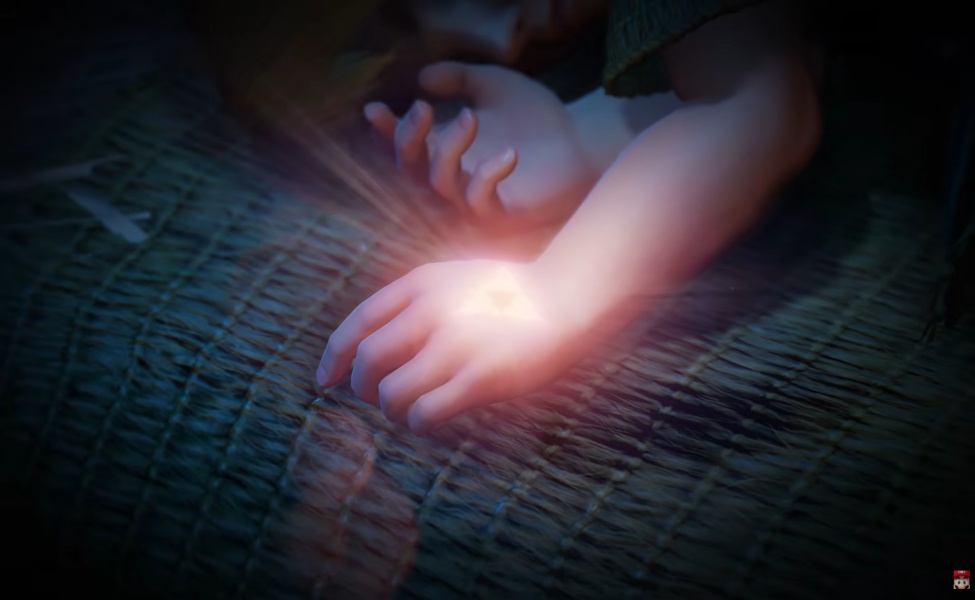
Then a shot of young Link sleeping in his Kokiri Forest home. That shot includes one detail the original N64 opening did not: the Triforce of Courage is already glowing faintly on the back of Link’s left hand. Before the adventure starts. Before Navi wakes him up.
That is not an accident. We will get into the story theories that detail is generating later. For now, note that Nintendo chose to include it in a 45-second teaser. Every frame in a teaser this short is a decision.
The audio is doing serious work throughout. The ocarina motifs from the 1998 score appear fully orchestrated, and the arrangement sounds layered in a way that the original’s MIDI tracks could not deliver.
Koji Kondo’s compositions hold up regardless of how you dress them, but hearing the Title Theme in that orchestral treatment, it lands. It’s unknown if the full game will feature a live orchestral score all the way through, or if it will mix arranged and original tracks, but the trailer makes it clear the musical direction is being taken seriously.
The visual style is being described as “stylized realism.” It is not the cel-shaded look of Breath of the Wild or Wind Waker HD. It is not the low-poly abstraction of the N64 original.
The closest reference point is Twilight Princess’s darker, more grounded aesthetic, but sharper and more detailed than anything Nintendo has shipped on prior hardware. The lighting appears modern, the environments rich.
Young Link’s character model is the clearest signal: he looks like a believable child in a hand-crafted world, not a stylized avatar. Whether that captures the charm of the N64 original is genuinely subjective, and the community is split on it; more on that shortly.
See also: Monopoly GO Codes (June 2026): Every Active Dice Link
The Art Style Debate
A segment of the fanbase is worried. The abstract, slightly-dreamlike geometry of the N64 version had a quality that was partly the technology’s limitation but also partly its personality.
Kokiri Forest felt like a child’s drawing of a forest. Ganon’s Castle felt genuinely alien. “Stylized realism” risks ironing out that strangeness in pursuit of polish.
The majority view, at least based on Reddit, ResetEra, and X reactions post-Direct, is strongly positive. Most players want to see Hyrule through modern hardware, and the trailer delivers that. The dissenting view is not wrong though.
Square Enix spent years defending Final Fantasy VII Remake’s changes, and the purist/modernizer tension is going to follow this game until it ships.
The difference is that OoT’s visual identity is tied to specific places and set pieces, the Sacred Forest Meadow, the bottom of Lake Hylia, the market of Hyrule Castle Town, and every one of those will be judged against the memory of the original the moment gameplay footage drops.
For now, the trailer sells the new direction confidently. We just need gameplay.
See Also: Rayman Legends Retold: Can Snowdrop Match 2D Physics?
QoL Changes: What a 2026 Rebuild Should Fix
The 2011 Ocarina of Time 3D on Nintendo 3DS was a remaster that solved several of the original’s biggest pain points. The Iron Boots were mapped to the touchscreen instead of requiring a full equipment menu swap. The Water Temple’s doors were color-coded to reduce the wall-staring confusion that traumatized an entire generation.
Master Quest was included as a separate mode. These were meaningful improvements, and the 3DS version remains the best way to play OoT on original-intent terms.
A full remake in 2026 goes further. Nintendo has confirmed modern accessibility options will be included. That is a broad statement, but the implication is that the 1998 design’s friction points, inventory management during combat, some of the Water Temple’s obtuse water level logic, and Navi’s interruptions will be addressed at a mechanical level rather than just cosmetically.
Here is what we are expecting based on insider claims and reasonable extrapolation from where game design standards are in 2026. The Z-Targeting system will be updated. The original’s lock-on was stiff by modern standards; the camera struggled in enclosed spaces and the sidehop/backflip movement system, while iconic, was a workaround for limited analog camera control.
A 2026 version built on Switch 2 hardware should give us a fully free camera, proper analog camera control, and a Z-Target that behaves closer to something like Monster Hunter Rise’s lock-on rather than the N64’s semi-fixed system.
The equipment menu situation is gone. Iron Boots, Hover Boots, and the rest of the B-slot items need to be mapped to quick-select radials or a D-pad shortcut. Every modern action-adventure handles this. There is no reason to preserve the menu-swap as a mechanic in a remake, and the 3DS version already started solving it.
Dungeon design is trickier. The Water Temple in particular is a structural maze that was confusing because of how the game communicated (or failed to communicate) its water level states. The 3DS color-coding helped.
A remake could go further with better map detail, visual indicators in the environment itself, or reworked pathfinding. The risk is making it too easy.
The Water Temple is hard in part because it rewards players who build a mental model of it; that challenge has value. The better solution is to improve communication without simplifying the underlying puzzle.
Hyrule Field is reportedly being rebuilt as a fully streaming, load-free zone. The original’s transition gates between zones triggered loading screens, which were part of the technical reality of cartridge hardware in 1998. Modern players notice these.
Eliminating them, the way Elden Ring eliminated world transitions, would be the right call and apparently is in the plan, with Monolith Soft (the Xenoblade team) rumored to be handling world design given their experience building the open-field environments for Breath of the Wild and Tears of the Kingdom.
See also: How to Play Roblox in Your Browser with Now GG
Z-Targeting, Movement Tech, and the Speedrunning Question
This is where it gets complicated, and we are going to be direct about it: the speedrunning community is watching this remake closely, and they have legitimate reasons to be cautious.
The N64 version of OoT has one of the deepest trick libraries of any 3D game ever made. Infinite Sword Glitch (ISG), hover boosting, the Wrong Warp exploits, Superslide, Bombchu hovering, Megaton Hammer early via sequence-breaking: these are not bugs to most of the community.
They are what the game becomes after you exhaust the intended experience. Any% speedruns of OoT are under ten minutes. That is a testament to how deeply the community has dissected this game over 28 years.
A ground-up rebuild changes the physics engine. It changes the collision detection. It almost certainly eliminates most or all of the movement exploits that define current categories. The 3DS version already patched several glitches, which is why the speedrunning community largely stayed on the N64 version for competitive play.
For this remake the question is not if the old glitches survive, they almost certainly don’t. The question is whether the new engine and design have enough new depth to allow for a new speedrunning scene to emerge.
FF7 Remake did this; it has its own tricks, its own viable speedrun categories, and its own community. A 2026 OoT Remake with modern physics and a free camera likely opens entirely new lines for clipping, out-of-bounds movement, and frame-data exploitation that do not exist in the original. Whether that happens depends on how much environmental detail and physics simulation the new engine includes.
Nintendo and its development partners have not said anything about this. They probably will not. The answer will come from the community after the game ships.
What we can say is this: if you are a veteran who played OoT Randomizer seeds last year or ran any% on Bizhawk, your relationship with this remake is going to be different from a newcomer’s. You will be relearning a game you thought you knew perfectly. That is actually exciting.
The original formula is still the best version of itself; every dungeon, every boss, every story beat, and having that rebuilt on hardware that can support it fully is something to want, even if the trick library starts at zero.
Switch 2 Hardware: What the Trailer Signals
The trailer was reportedly captured in 4K, and the visual fidelity is consistent with Switch 2’s docked output capabilities.
Nintendo’s new hardware includes a DLSS-equivalent upscaling pipeline, which allows the console to render at a lower native resolution and output clean 4K in docked mode. The trailer’s lighting and environment detail are well beyond what Switch 1 could sustain at stable framerates.
The streaming world design (no load screens) relies on Switch 2’s faster storage throughput. The original Switch used cartridge and microSD with limited streaming bandwidth. Switch 2’s internal storage is faster, which is what makes a fully load-free Hyrule Field technically viable rather than just aspirational.
We have not seen a framerate target confirmed. 60fps docked seems like the expectation for a first-party action title on Switch 2 in 2026, but Nintendo has occasionally prioritized visual fidelity over framerate on certain titles. The safe assumption is 60fps docked, 30fps or adaptive in portable mode.
See Also: God of War Laufey: The Shocking Multi-Mythology Twist
The “Reborn” Theory and That Triforce Detail
The glowing Triforce of Courage on Link’s hand in the opening shot has generated serious discussion. In the original game, Link does not receive the Triforce of Courage until very late; it is Zelda who identifies him as the bearer. The original opening shows him sleeping without it. Showing it glowing before the adventure begins implies either narrative foreknowledge or a story loop: Link carrying memory or power from a completed timeline into the start of the new one.
The community has drawn comparisons to Final Fantasy VII Remake’s use of Whispers and the Remake trilogy’s overall “destiny correction” plot.
Nintendo almost certainly knows this comparison will be made. Using the word “reborn” in the trailer tagline while showing a detail that was absent from the original’s opening is deliberate signaling of some kind.
The conservative reading is that it is a visual flourish, a way to signal “this is a remake, not a port” without committing to story changes. The more interesting reading is that Nintendo is giving itself narrative room to expand the experience without contradicting the original canon.
Nobody outside the development team knows what that means: new side quests, an expanded Sheik storyline, or something more structural in the main plot.
What we do know is that Nintendo confirmed no episodic split. The full story ships in one package. That rules out a Remake-style multi-game retelling, which means any story expansion happens within the scope of the original’s arc.
Insider Intel: Why the Leaks Hold Up
NateTheHate correctly called the June 9 reveal date, the existence of a new Star Fox title alongside the Zelda announcement, and the Holiday 2026 release window months before Nintendo confirmed any of it. His characterization of this as a full remake (not a simple HD remaster) has been corroborated by Video Games Chronicle and IGN’s own reporting.
Nash’s earlier 2022 rumors about Monolith Soft involvement have not been officially confirmed but have not been contradicted either, and the seamless world design fits exactly with Monolith’s known capabilities from their Breath of the Wild work.
The development reportedly started around 2022, which gives the project roughly four years of production time before a 2026 ship date. That is a reasonable timeline for a game of this scope. Eiji Aonuma’s team is the presumed lead, which is consistent with every mainline Zelda entry.
Nintendo was reportedly unhappy about how much leaked ahead of the Direct. That tracks. The announcement had no genuine surprises left in it by the time it aired. But everything that leaked proved accurate, which is actually useful for calibrating expectations: if NateTheHate says Holiday 2026, we should take that seriously.
See Also: Desert Storm Map Strategy: Last War Survival Guide
The Legend of Zelda: Ocarina of Time Remake is the most significant preservation and modernization project Nintendo has undertaken for its new hardware generation.
Balancing the purity of the 1998 dungeon design with the fluidity of 2026 combat and seamless overworld streaming is a monumental task. The Switch 2 architecture provides the processing power required to realize Hyrule exactly as our childhood memories perceived it.
Experiencing a legendary masterpiece completely rebuilt from the ground up is an absolute day-one purchase, and making sure your digital wallet is fully stocked with fast, secure, and affordable top-ups at Joytify is the smartest way to ensure you’re ready to dive back into Hyrule without delay.
FAQs
It is a remake, not a sequel. Nintendo is rebuilding the original Ocarina of Time from the ground up for Nintendo Switch 2 rather than creating a new story.
Nintendo officially announced the remake during their June 9, 2026 Nintendo Direct presentation with a cinematic teaser.
The remake will be exclusive to Nintendo Switch 2 and is scheduled to launch sometime in late 2026.
TL;DR
- Nintendo confirmed the remake of The Legend of Zelda: Ocarina of Time during the June 9, 2026 Nintendo Direct, stating it will be exclusively for the Nintendo Switch 2 and is set to launch in late 2026.
- The remake is described as a 'rebirth' rather than a remaster or port, indicating significant changes and updates to the original game, including modern accessibility options and potential quality of life improvements.
- The visual style of the remake will feature 'stylized realism,' aiming for a more grounded aesthetic while maintaining the essence of the original game, though this has sparked debate among fans regarding the preservation of the original's charm.